
 KNOWLEDGE REFINERY® (KR)
You can’t transform what you can’t see. You shouldn’t automate what you don’t understand.
KR extracts your operational knowledge from your code—capturing how it actually runs—and turns it into a blueprint that your teams and AI agents can use for daily operations, digital transformation, compliance, resilience, and other business challenges.
KR knows. AI learns.

Most of your operations are embedded in code you can’t see.
Banks, insurers, healthcare systems, transportation networks, and government agencies run on precise logic, encoded in millions of lines of code. Modernization, mergers, compliance and AI all depend on knowing that logic before you change it.
KR products build, maintain, and provide access to your operational blueprint.

The primary KR product: four pieces installed together
KR Engine — Our primary workhorse extracts operational knowledge from code, structures it into the “Knowledge Stack” framework, and loads it into the KR Repository.
The Knowledge Stack defines the specific workflows, data lineage, rules, terms, dependencies, structures, and code paths of your operations. Its seven layers provide the common framework for deterministic knowledge—whether extracted, observed, or visual.
L6: Integrated workflows and data lineage
L5: Human-run workflows
L4: Software-run processes
L3: Data lineage
L2: Business rules and business terms
L1: System dependencies, architecture and data structures
L0: Code and code paths
KR Repository — Stores your operational blueprint, organized in the seven-layer knowledge stack.
Holds everything KR Engine extracts: the specific workflows, data lineage, rules, terms, dependencies, structures, and code paths in your operations, traceable to source. KR Assistant, KR Data Consolidator, KR Advisor, KR Interpreter, and KR Integrator work from it. AI agents reach it through KR Advisor, over MCP; other software exchanges files with KR.
KR Assistant — Provides a human-directed interface between KR and your AI platform.
Users select and query KR’s operational knowledge, direct KR Assistant to send that knowledge to AI through the platform’s API for specific tasks, and return the AI-generated results to KR. (Licensed functionality inside KR, not a separate product. Does not use MCP.)
KR Data Consolidator — Delivers a relational database design from the data structures KR extracts, including flat files, joining or separating tables and adding referential integrity.
Works inside KR from the data structures KR extracts, helping you design the “to-be” relational database, including when moving from older file-based, hierarchical or network databases.
Installed on top of KR
NEW: KR Advisor — Provides an agent-directed interface that allows AI agents (on MCP-compatible platforms) to query the KR repository with read-only access.
Because the knowledge is deterministic and traceable to source, the agents’ outputs are more precise and defensible than with inferred or observed context alone. A separate product installed on top of KR, KR Advisor can be used with any AI platform compatible with MCP. Then AI agents can use the operational blueprint for questions about compliance, transformation, modernization, and project planning.
KR Interpreter — A separate product that finds clear names and descriptions for extracted terms and rules.
Your analysts review and refine the names and descriptions it suggests.
KR Integrator — Shows how your operations flow end to end across a portfolio of applications and databases, when an operation is too large to understand one application at a time.
A separate product that performs cross-portfolio analysis. Portfolio Analysis links multiple applications and databases into one view, discovering the interfaces between them, extending data lineage across them, and building workflows that span them. Rationalization examines one or more applications or databases for duplication, differences, and other factors. Use results to consolidate overlapping operations after an M&A or to verify that modernization preserved what the original operation was required to do.
Your other software
Data exchange — KR exports and imports data in XML, BPMN, and CSV to exchange it with your other software.
Formatted files for data exchange, supporting custom integrations with the tools you already run. It is not direct database access.
KR layers your knowledge.
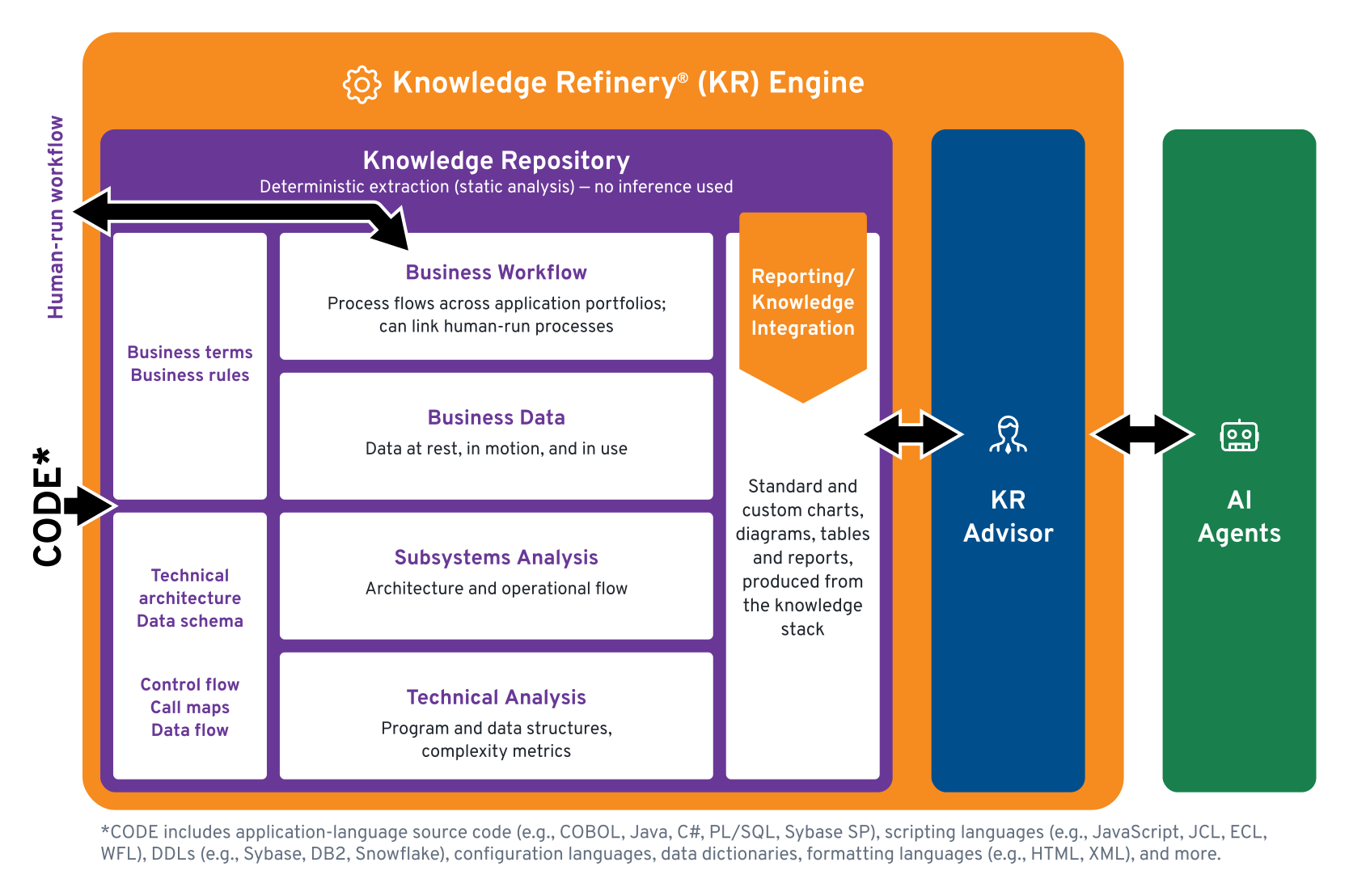
KR extracts the operational blueprint by deterministic extraction (static analysis, not inference) and loads it into the repository. The seven-layer knowledge stack connects the specific workflows, data lineage, rules, terms, dependencies, structures, and code paths in your operations, from the code up to integrated workflows and data lineage, traceable to source. Reports, diagrams and charts are highly customizable, so you can look at the blueprint from any direction.
Let the model be probabilistic. But ground the operation in traceable evidence.
Your AI agents consume KR’s operational blueprint as the foundation for accuracy and the guardrails for agentic AI. You can verify their execution against that same blueprint, one step at a time, toward controlled autonomy.
Who uses KR and why?
- Executive leadership
- Operational managers
- Risk and compliance managers
- Business and systems analysts
- Cybersecurity analysts
- DevSecOps teams
- AI and data teams
- Transform and Modernize. Plan cloud migration around operational boundaries. Consolidate and retire redundant applications and data.
- Manage Risk and Compliance. Trace requirements, risk and resilience across the operation.
- Guide Enterprise AI. Give AI agents the operational knowledge they need across applications and databases. Move AI agents toward controlled autonomy.